
In-depth analysis on today's most pressing issues
Dive into thoughtful commentary and expert insights on Irish and global affairs, unpacking the stories that shape our world with clarity and depth.
6/5/20265 min read
What Singapore Can Teach Ireland About Solving a Housing Crisis
As Ireland struggles with rising rents, soaring house prices and record homelessness, policymakers may find valuable lessons in one of the world's most successful housing systems.
By Mehdi OZCINAR
Ireland's housing crisis has evolved from a political talking point into one of the most serious social and economic challenges facing the nation.
For over a decade, governments have promised reforms, announced ambitious construction targets, and introduced various schemes aimed at improving affordability. Yet for many Irish citizens, the situation appears to be worsening rather than improving.
House prices have climbed beyond the reach of many first-time buyers. Rents continue to consume an increasing share of household income. Thousands remain trapped in temporary accommodation, while homelessness figures have reached levels few would have imagined a generation ago. Young adults are delaying homeownership, postponing starting families, and in some cases emigrating in search of better opportunities abroad.
The consequences extend far beyond the housing market. Employers struggle to recruit workers in major cities due to accommodation shortages. Public services face increased pressure. Economic growth risks being constrained by a lack of available housing near centres of employment. Most importantly, confidence in the ability of government to provide practical solutions has been steadily eroded.
Ireland is not alone in facing these challenges. Housing affordability has become a growing concern across much of the developed world. However, while many countries continue to grapple with housing shortages, one nation stands out as an example of what can be achieved through long-term planning and political determination.
That nation is Singapore.
At first glance, comparisons between Ireland and Singapore may seem unusual. Singapore is a densely populated city-state with limited land and a population approaching six million people. Ireland, by contrast, possesses considerably more land and a far lower population density.
Yet despite these disadvantages, Singapore has succeeded in delivering affordable housing on a scale that many Western nations can only envy.
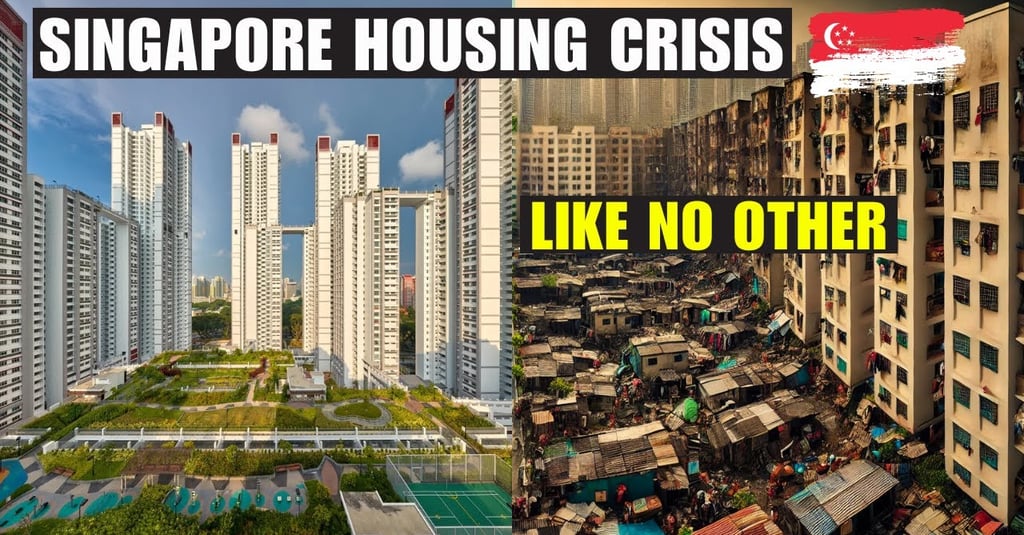
More than 80 percent of Singapore's population lives in public housing developed by the government, while around 90 percent of residents own their homes. Housing is viewed not simply as a commodity or investment vehicle, but as a fundamental pillar of national development and social stability.
While Ireland cannot simply copy Singapore's model, there are important lessons worth examining.
A Crisis That Forced Action
When Singapore gained self-government in 1959, it faced severe housing shortages. Large numbers of citizens lived in overcrowded settlements lacking basic sanitation, infrastructure, and essential services.
Rapid population growth only intensified the challenge.
Recognising the scale of the problem, the government established the Housing and Development Board (HDB) in 1960. Rather than treating housing as a secondary policy issue, Singapore made it a national priority.
The objective was straightforward: build enough homes to ensure every citizen had access to safe, affordable housing.
Unlike many governments that focused on short-term initiatives, Singapore committed itself to a decades-long strategy supported by consistent investment and planning.
Building Homes at Scale
Perhaps the most important lesson from Singapore is a simple one: housing shortages cannot be solved without building sufficient homes.
While debates about planning regulations, taxation, and subsidies remain important, none can compensate for a lack of supply.
Singapore recognised this early and embarked on one of the largest public housing programmes in modern history. Large-scale developments were constructed year after year, ensuring that housing supply broadly kept pace with population growth and economic development.
In Ireland, housing targets have often fallen short of actual demand. Planning delays, infrastructure constraints, labour shortages, and rising construction costs have all contributed to an insufficient supply of new homes.
Singapore's experience demonstrates that solving a housing crisis ultimately requires governments to build at a scale that matches the problem.
Treating Housing as Infrastructure
One of Singapore's most significant achievements was changing how housing was viewed.
Housing was not considered merely a market transaction between buyers and sellers. It was treated as essential infrastructure in the same way governments view roads, hospitals, schools, and public transport.
Entire communities were designed rather than simply constructed.
New housing developments included schools, healthcare facilities, parks, shops, public transport connections, and recreational spaces. Residents were not just given apartments; they were given functioning neighbourhoods.
This integrated approach helped create communities that remain attractive and sustainable decades after construction.
Ireland's housing debate often focuses narrowly on unit numbers. Singapore's experience suggests that successful housing policy must also consider the broader communities being created.
Government Leadership and Long-Term Planning
A defining characteristic of Singapore's housing strategy has been consistency.
Policies were developed with decades in mind rather than election cycles.
Governments maintained a clear vision and continued investing regardless of changing economic conditions. This long-term approach provided certainty for developers, investors, and citizens alike.
Ireland's housing policy has often suffered from short-term thinking. Strategies change, targets are revised, and projects can become entangled in lengthy administrative processes.
Singapore's success highlights the importance of political leadership willing to pursue long-term solutions even when immediate results are not guaranteed.
Promoting Homeownership
Singapore also prioritised homeownership as a cornerstone of its housing policy.
The government viewed homeownership not only as an economic objective but as a means of strengthening social cohesion and giving citizens a stake in their country's future.
Through the Central Provident Fund (CPF), Singaporeans can use compulsory savings to help finance home purchases, reducing barriers to entry for many families.
The result has been one of the highest homeownership rates in the world.
For many Irish citizens, particularly younger generations, homeownership increasingly feels out of reach. While Singapore's exact financing model may not be transferable, its commitment to making ownership attainable offers an important lesson.
The Limits of the Singapore Model
Of course, Singapore's approach is not without critics.
The country's political system is more centralised than Ireland's, allowing decisions to be implemented more quickly. Government ownership of most land provides powers that few democratic governments possess.
Critics also argue that Singapore's model would be difficult to replicate fully in larger countries with different legal systems and traditions of property rights.
These criticisms are valid.
No nation can simply import another country's policies wholesale. Successful reforms must reflect local conditions and democratic realities.
Nevertheless, dismissing Singapore's achievements because they cannot be copied exactly would be a mistake.
The principles behind the model remain highly relevant.
Lessons for Ireland
Ireland does not need to become Singapore.
However, Ireland can learn from Singapore's willingness to think long-term, build at scale, integrate infrastructure with housing development, and treat affordable housing as a national priority rather than a recurring political issue.
The housing crisis was not created overnight, and it will not be solved overnight. Yet Singapore's experience proves that determined governments can dramatically improve housing affordability when they combine strategic planning with sustained investment.
For a generation of Irish people increasingly concerned about whether they will ever own a home, that lesson offers something often missing from discussions about housing: hope.
The question facing Ireland is not whether solutions exist.
The question is whether policymakers possess the ambition, urgency, and political courage required to implement them.